
September Scientist of the Month: Alexander Wetmore
Ornithologist

Alexander Wetmore
1886 - 1978 ornithologist or bird scientist
Birthplace: North Freedom, Wisconsin
Education: B.S. 1912 University of Kansas, M.S. 1916, and Ph.D 1920 George Washington University
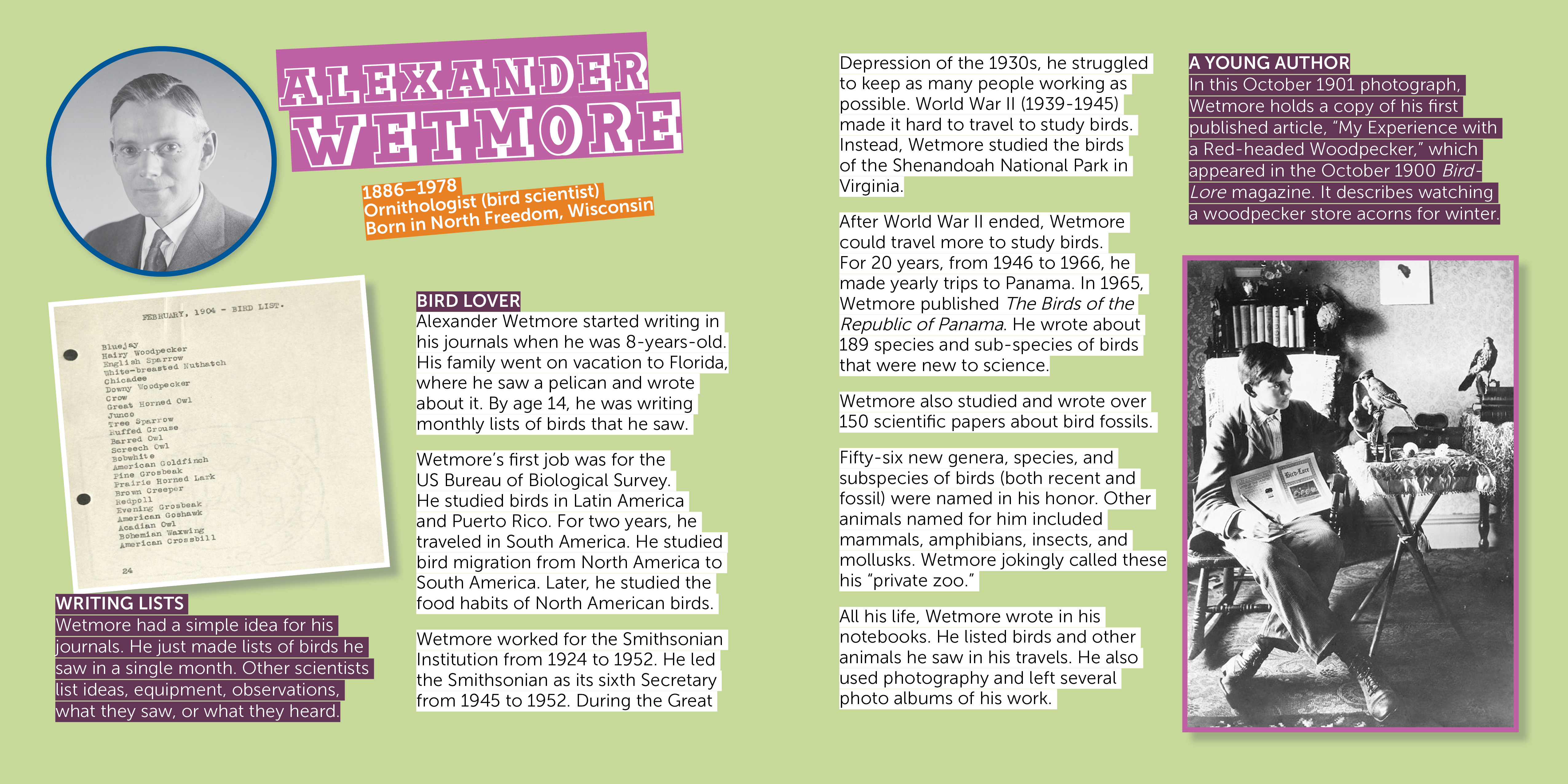
Alexander Wetmore started writing in his journals at 8-years-old. His family went to Florida for vacation. He saw a pelican and wrote about it. By age 14, he was writing monthly lists of birds that he saw.
His first job was for the U.S. Bureau of Biological Survey. He studied birds in Latin America and Puerto Rico (1911). For two years, he traveled in South America. He studied bird migration from North America to South America. Later he studied the food habits of North American birds.
Wetmore worked for the Smithsonian Museum from 1925-52. He served as the sixth Secretary from 1945-52. During the Great Depression of the 1930s, he struggled to keep as many people working as possible. World War II from 1939-1945 made it hard to travel to study birds. Instead, he studied birds of the Shenandoah National Park in nearby Virginia.
After the war ended, Wetmore could travel more to study birds. From 1946-1966, Wetmore made yearly trips to Panama. He wanted to study all the birds of Panama. He later published a book, The Birds of the Republic of Panama (1984). Wetmore wrote about 189 species and sub-species of birds that were new to science.
During his travels, Wetmore brought back 26,058 bird and mammal skins. He also collected 4,363 skeletal and anatomical specimens. Also, he brought back 201 clutches of birds eggs.
Many birds, animals and plants were named in his honor. There were 56 new genera, species, and subspecies of birds (both recent and fossil). Other animals named for him included mammals, amphibians, insects, and mollusks. Also, some plants were named for him. Wetmore jokingly called these his “private zoo.”
All his life, Wetmore wrote in his notebooks. He wrote lists of the birds and other animals he saw in his travels. He wrote many letters. He also used photography and left several photo albums of his work.
DOWNLOAD THE FULL PACKET OF INFORMATION ABOUT ALEXANDER WETMORE
WRITING IN ALEXANDER WETMORE’S JOURNALS
The simplest type of science writing, suitable for even Kindergarten, is to write a list. At age 8, Alexander wrote a list of birds he saw on a beach vacation. He never stopped writing lists of birds he saw, usually keeping a monthly journal.
Kids can write lists of many things: classroom furniture, food on their lunch tray, or things they saw (heard, touched, felt) on the playground. See the packet for more writing prompts.
Each month will also feature STEAM discussion questions. Field journals from scientists include many fascinating things about science, technology, engineering, art, and math.